
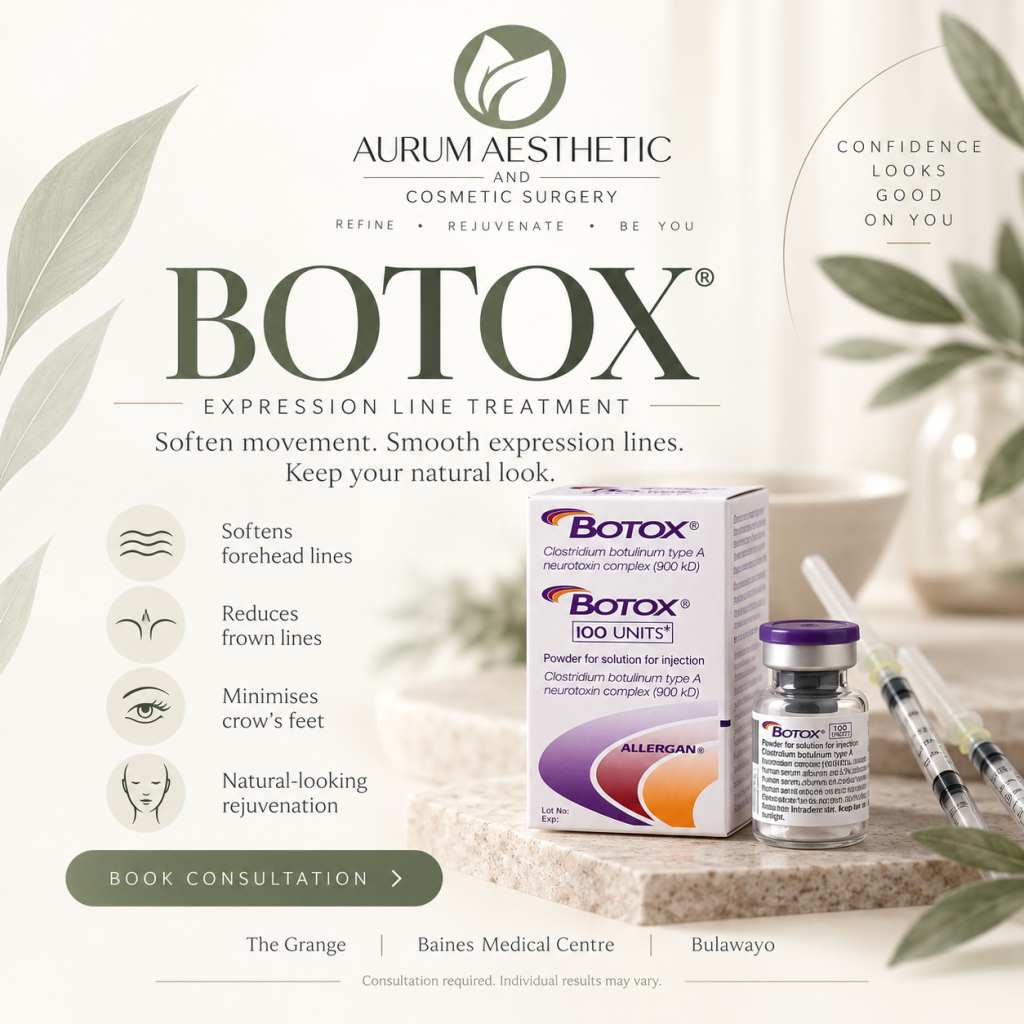
Botox in Zimbabwe: What First-Time Clients Should Know Before Treatment
Botox is one of the most recognised aesthetic treatments in the world, yet it is also one of the most misunderstood.
At AURUM Aesthetic & Cosmetic Surgery, one of the most common things we hear from first-time clients is:
“I want Botox, but I don’t want to look frozen.”
That concern is understandable. Many people still associate Botox with expressionless faces, raised eyebrows or an obviously “done” appearance. In our experience, however, good Botox should not make you look like somebody else.
It should make you look like you — refreshed, softer and well-rested.
Our philosophy at AURUM is simple: we do not treat wrinkles in isolation. We assess the whole face, the way the muscles move, existing facial asymmetry, skin quality and, most importantly, what the client actually wants to achieve.
This guide explains what Botox really does, what it cannot do, how we approach treatment at AURUM, and what first-time clients considering Botox in Zimbabwe should know before booking.
What Exactly Is Botox?
Botox is a brand name for onabotulinumtoxinA, a purified botulinum toxin type A product used medically and cosmetically.
In aesthetic treatment, Botox works by temporarily reducing the activity of selected muscles. Repeated facial movements — such as frowning, raising the eyebrows and smiling — contribute to the formation of expression lines over time. By reducing some of that muscle activity, Botox can soften the appearance of those lines.
The important word here is temporarily.
Botox does not permanently paralyse the face, and it does not remove every wrinkle.
Its role is primarily to modify muscle movement in carefully selected areas.
The AURUM Approach: Botox Should Still Look Like You
For us, successful Botox is not about removing every line from somebody’s face.
It is about balance.
A person should still be able to smile, communicate and show emotion. Our aim is usually to soften the muscular patterns that make someone look more tired, tense or aged than they feel.
This is why two people of the same age may receive completely different treatment plans.
One person may have very strong forehead muscles but relatively little movement around the eyes. Another may have pronounced frown lines but naturally low brows. Treating both people with the same injection pattern or dose would not necessarily produce the best result.
Good aesthetic treatment begins with assessment, not with a syringe.
Which Areas Can Botox Treat?
Some of the most commonly requested cosmetic areas include:
forehead lines
frown lines between the eyebrows
crow’s feet around the eyes
Botox Cosmetic is specifically used to temporarily improve the appearance of moderate to severe forehead lines, frown lines and crow’s feet in adults.
Depending on clinical assessment, botulinum toxin may also be used in other areas or for other concerns, but suitability depends on anatomy, indication, product labelling and the practitioner’s scope of practice.
At AURUM, we prefer to start by asking:
What bothers the client? What is causing it? And is Botox actually the correct treatment?
Sometimes it is.
Sometimes filler, skin boosters, collagen stimulation or skin treatment would be more appropriate.
Botox vs Fillers: What Is the Difference?
This is one of the most common questions we receive.
The easiest way to explain it is:
Botox mainly treats muscle movement.
Fillers mainly treat volume and structure.
If a forehead line becomes deeper when you raise your brows, muscle activity may be a major contributor.
If the concern is loss of cheek volume, facial hollowing or structural support, Botox is not necessarily the correct solution.
This distinction matters because clients sometimes request Botox for concerns that are actually related to volume loss, skin laxity or poor skin quality.
Botox vs Skin Boosters, Sculptra, PDRN and Rejuran
Modern aesthetic medicine gives us more options than ever before, but those treatments do different jobs.
Botox reduces selected muscle activity.
Dermal fillers restore or create volume and structural support.
Skin boosters are typically used to improve hydration and skin quality.
Sculptra and other biostimulators are used to stimulate collagen production gradually.
PDRN and Rejuran-style treatments are generally positioned around skin quality, repair and regeneration.
This is why we often tell clients:
Do not choose a treatment because it is trending. Choose it because it addresses your actual concern.
Who Is a Good Candidate for Botox?
There is no single “correct age” for Botox.
Some clients begin noticing expression lines in their late twenties or thirties. Others may not consider treatment until much later.
The severity of muscle movement, facial anatomy, skin quality and personal preferences matter more than age alone.
The official Botox Cosmetic guidance similarly notes that treatment suitability is not simply determined by age; the severity of the lines and professional assessment are important.
At AURUM, we generally look at:
facial movement
muscle strength
asymmetry
brow position
skin quality
previous treatments
medical history
medications
expectations
treatment goals
What Does a Botox Consultation Involve?
A good consultation should involve more than simply pointing at a wrinkle.
We assess the face at rest and during movement.
A client may be asked to:
raise the eyebrows, frown, smile or contract specific facial muscles.
This allows us to understand how the muscles interact.
We also look for pre-existing asymmetry. Almost every human face has some degree of natural asymmetry, and recognising this before treatment is important.
We then discuss what the client wants.
Sometimes a client says:
“I want my forehead completely smooth.”
But after assessment, preserving some movement may produce a more natural and aesthetically balanced result.
What Is “Baby Botox”?
“Baby Botox” is an informal term generally used to describe more conservative dosing.
It can be suitable for some first-time clients or people who want a softer reduction in movement rather than a stronger effect.
However, lower dosing is not automatically better.
The correct amount depends on muscle strength, anatomy and treatment goals.
Someone with very strong muscles may need a different approach from someone with subtle movement.
Again, individualisation matters more than trends.
Does Botox Make You Look Frozen?
It can look unnatural if treatment is inappropriate, excessively aggressive or poorly planned.
But a frozen appearance is not an inevitable result of Botox.
The official Botox Cosmetic information describes treatment as capable of producing subtle, natural-looking results when appropriately administered.
Our preference at AURUM is generally to preserve enough expression that the face still feels natural.
Aesthetic medicine should enhance confidence, not erase personality.
When Will I See Botox Results?
Results do not usually appear immediately.
Some people begin noticing a change within the first few days. The effect continues to develop after treatment.
The manufacturer states that changes may begin within approximately 1–2 days, with fuller results developing later, depending on the treatment area.
This is why clients should not panic if they do not see a dramatic difference the morning after treatment.
Botox needs time to work.
How Long Does Botox Last?
For commonly treated cosmetic facial areas, effects can last up to around four months, although individual results vary.
Duration can differ depending on:
muscle strength
treatment area
dose
individual metabolism
treatment history
product used
Some clients feel their treatment lasts longer than others.
That does not necessarily mean something has gone wrong.
What Happens at a Botox Review?
A review is useful because Botox should be assessed after the treatment has had enough time to take effect.
During review, we can assess:
symmetry
movement
whether the desired softening has occurred
whether any area requires further clinical consideration
The aim is not automatically to add more product.
Sometimes the best decision is to leave a good result alone.
Is Botox Painful?
Most people describe the injections as small pinches.
Treatment of common facial areas can be relatively quick, and the official Botox Cosmetic information describes treatment as typically taking around 10–15 minutes for the forehead, frown lines and crow’s feet.
Tolerance varies, but the treatment is generally brief.
What Are the Possible Side Effects?
Botox is a medical treatment, and clients should understand that side effects and complications are possible.
Depending on the area treated, possible effects may include:
bruising
tenderness
headache
temporary asymmetry
heaviness
unintended weakness of nearby muscles
eyelid or brow drooping in some cases
This is why injector training, facial anatomy knowledge, proper assessment and genuine product sourcing matter.
Clients should always disclose relevant medical history, medications, previous reactions and previous aesthetic treatments before treatment.
Why Choosing the Cheapest Botox Can Be a Mistake
Price is understandably important, but Botox should not be purchased in the same way as an ordinary beauty service.
You are not simply paying for “an injection.”
You are paying for:
consultation
anatomical assessment
genuine product
appropriate storage and handling
dosing decisions
injection technique
clinical judgement
follow-up
management if something unexpected occurs
Counterfeit botulinum toxin products have been reported internationally, reinforcing the importance of receiving treatment from legitimate providers using appropriately sourced products.
At AURUM, we encourage clients to ask questions about the product being used and the practitioner performing the treatment.
Botox Cost in Zimbabwe: What Determines the Price?
There is no single universal Botox price because treatment plans differ.
Cost may depend on:
number of areas
amount of product required
muscle strength
treatment goals
product used
practitioner and clinic costs
A client with strong frown muscles may require a different plan from someone seeking very subtle preventative treatment.
For this reason, consultation remains the best way to determine an appropriate treatment plan and price.
Our Experience With First-Time Botox Clients
One pattern we see frequently is that first-time clients are far more nervous than they need to be.
Their main fear is usually:
“What if everyone can tell I had Botox?”
Interestingly, after treatment, many clients say they simply look more rested.
Friends may notice that they look refreshed without immediately identifying why.
For us, that is often a successful aesthetic result.
The treatment should not enter the room before the person does.
A Typical Botox Case
A common example is a client in her late thirties who presents with strong forehead movement and pronounced frown lines.
Even when she is relaxed, the lines may give her a tired or tense appearance.
Instead of aggressively treating every visible line, the clinical approach may focus on reducing excessive muscle activity while preserving natural brow movement.
At follow-up, the desired result is softer lines and a more rested appearance while the client still looks unmistakably like herself.
Individual results vary, and every treatment plan should be personalised.
Preventative Botox: Does It Make Sense?
Preventative Botox refers to treating expression-related muscle activity before lines become deeply established.
The concept can make sense in selected clients, but it should not become a reason for everybody in their twenties to receive Botox automatically.
We believe treatment should respond to an actual concern.
Age alone is not an indication.
When Botox Is Not the Right Treatment
Botox cannot solve every aesthetic problem.
For example:
Deep static lines may also involve loss of collagen and skin quality.
Facial volume loss may require a completely different approach.
Pigmentation problems need skin treatment rather than neuromodulation.
Skin laxity may require collagen stimulation or other procedures.
This is why our consultations often include discussion of alternatives.
Sometimes telling a client not to have Botox is part of good aesthetic care.
Botox and Natural Ageing
Our philosophy at AURUM is not about trying to make a 50-year-old look 20.
Ageing is normal.
Our role is to help clients who choose aesthetic treatment feel confident and look refreshed while respecting their natural features.
We prefer:
refreshed rather than frozen
balanced rather than exaggerated
individualised rather than standardised
Frequently Asked Questions About Botox in Zimbabwe
How long does Botox last?
For common cosmetic facial areas, results can last up to approximately four months, although this varies between individuals.
How quickly does Botox work?
Some clients may start seeing changes within the first few days, with results continuing to develop afterwards.
Can Botox prevent wrinkles?
By temporarily reducing repetitive muscle activity, Botox may help reduce the development or deepening of certain expression lines. It does not prevent every type of ageing.
Is Botox the same as filler?
No. Botox primarily modifies muscle activity, while fillers are used mainly for volume and structural support.
Will Botox change my face?
A carefully planned treatment should aim to preserve your individual appearance rather than make you look like a different person.
What areas can be treated?
Common cosmetic areas include the forehead, frown lines and crow’s feet. Other uses require individual clinical assessment.
Is Botox suitable for men?
Yes. Men also seek Botox for expression lines and other appropriate indications. Treatment planning may differ because facial anatomy and muscle strength vary.
Is Botox permanent?
No. Botox is temporary.
Should I choose Botox based on price?
Price matters, but provider qualifications, genuine product, consultation, anatomy knowledge and aftercare should also form part of the decision.
Why Choose AURUM for Botox in Zimbabwe?
At AURUM Aesthetic & Cosmetic Surgery, our approach is centred on assessment, individualisation and natural-looking results.
We believe aesthetics should never feel like a production line.
Every face is different.
Every client has different goals.
And sometimes the best treatment plan involves Botox, while sometimes it involves something entirely different.
Our goal is to guide clients toward the treatment that makes sense for them rather than simply selling the treatment they initially request.
Considering Botox?
If you are considering Botox in Harare, Bulawayo or Zimbabwe, start with a consultation.
A proper assessment gives you the opportunity to understand:
whether Botox is appropriate
which areas may benefit
what results are realistic
what alternatives may be available
what your personalised treatment plan may involve
Book a consultation with AURUM Aesthetic & Cosmetic Surgery and let us assess what your face actually needs.
Written by Pamela Munemo, Founder of AURUM Aesthetic & Cosmetic Surgery
AURUM provides aesthetic, cosmetic and regenerative treatment services in Zimbabwe.
Medically reviewed by Dr Tanaka Makwanya, MBchB University of Zimbabwe